


Have you ever wondered how many seconds pass in a single day? We often measure our lives in hours and minutes, but seconds help us understand time in much greater detail. From setting a stopwatch and planning daily activities to calculating travel time and solving mathematics problems, knowing how many seconds are in a day can be surprisingly useful. The answer is simple: there are 86,400 seconds in a standard 24-hour day. You can calculate this number by multiplying 24 hours by 60 minutes and then multiplying the result by 60 seconds. In this guide, you will learn how to calculate the number of seconds in a day, why the total is 86,400, how seconds relate to other units of time, and how this calculation applies to everyday life.
How Many Seconds Are in a Day?
A standard day contains 86,400 seconds. This calculation is based on the familiar 24-hour day used for everyday timekeeping.
Each hour contains 60 minutes, and each minute contains 60 seconds. Therefore, to find the total number of seconds in one day, multiply these units together.
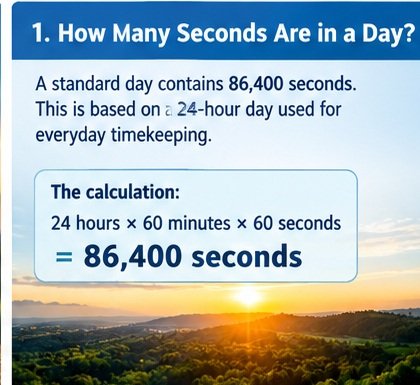
The calculation is:
24 hours × 60 minutes × 60 seconds = 86,400 seconds
This means that every standard 24-hour period contains 86,400 seconds.
Whether you are calculating a daily schedule, completing a school assignment, working with a computer program, or simply satisfying your curiosity, this number provides a reliable starting point.
How to Calculate the Number of Seconds in a Day
Calculating the number of seconds in a day is easy when you break the process into three simple steps.
Step 1: Find the Number of Hours
A standard day contains 24 hours. This is the starting point for the calculation.
Step 2: Convert Hours Into Minutes
There are 60 minutes in every hour. Multiply 24 by 60 to determine the total number of minutes in a day.
24 × 60 = 1,440 minutes
Therefore, one day contains 1,440 minutes.
Step 3: Convert Minutes Into Seconds
Each minute contains 60 seconds. Multiply the total number of minutes by 60.
1,440 × 60 = 86,400 seconds
The final answer is 86,400 seconds in one day.
You can also complete the entire calculation in one line:
24 × 60 × 60 = 86,400 seconds.
This straightforward method works whenever you need to convert a standard 24-hour day into seconds.
How Many Seconds Are in Different Units of Time?
Understanding how seconds relate to other time measurements makes time conversions easier. The following table provides a quick reference.
| Unit of time | Equivalent in seconds |
| 1 second | 1 second |
| 1 minute | 60 seconds |
| 5 minutes | 300 seconds |
| 10 minutes | 600 seconds |
| 30 minutes | 1,800 seconds |
| 1 hour | 3,600 seconds |
| 12 hours | 43,200 seconds |
| 24 hours | 86,400 seconds |
| 2 days | 172,800 seconds |
| 7 days | 604,800 seconds |
| 30 days | 2,592,000 seconds |
These values assume ordinary time intervals without adjustments for leap seconds or changes in local clock time.
How Many Seconds Are in a Week, Month, and Year?
The number of seconds increases quickly when you calculate longer periods. You can find the total by multiplying 86,400 by the number of days involved.
Seconds in a Week
A standard seven-day week contains:
86,400 × 7 = 604,800 seconds
Therefore, there are 604,800 seconds in one week.
Seconds in a 30-Day Month
Months have different lengths, so the answer depends on the specific month. For a month containing 30 days:
86,400 × 30 = 2,592,000 seconds
A 30-day period contains 2,592,000 seconds.
Seconds in a 31-Day Month
For a month containing 31 days:
86,400 × 31 = 2,678,400 seconds
This means a 31-day period contains 2,678,400 seconds under the standard-day calculation.
Seconds in a Year
A common year contains 365 days. Multiplying 365 by 86,400 gives:
365 × 86,400 = 31,536,000 seconds
A leap year contains 366 days:
366 × 86,400 = 31,622,400 seconds
These calculations use 24-hour days. Actual elapsed time can differ slightly in specialized timekeeping situations.
Why Are There 86,400 Seconds in a Day?
The answer comes from the way we divide a day into smaller units of time. For everyday purposes, a day is divided into 24 hours, each hour into 60 minutes, and each minute into 60 seconds.
The mathematical relationship is:
- 24 hours per day
- 60 minutes per hour
- 60 seconds per minute
Multiplying these values produces 86,400 seconds.
The second is also a scientific unit of time defined using the properties of the cesium-133 atom. Modern timekeeping relies on extremely precise atomic measurements rather than simply counting the apparent movement of the Sun.
Earth’s rotation is not perfectly uniform, however. The actual length of a solar day can vary slightly, and specialized timekeeping systems account for such differences when necessary. For everyday calculations, the standard figure of 86,400 seconds remains correct and convenient.
Practical Uses of Knowing How Many Seconds Are in a Day
Knowing how many seconds are in a day is useful in more situations than you might expect.
1. Managing Your Daily Schedule
Converting hours and minutes into seconds can help you calculate the duration of activities precisely. For example, a 15-minute break lasts 900 seconds, while a one-hour meeting lasts 3,600 seconds.
2. Solving Mathematics Problems
Students frequently need to convert time units when solving arithmetic, physics, and measurement questions. Remembering that a standard day contains 86,400 seconds makes these calculations easier.
3. Programming and Computer Systems
Software often represents time as a number of seconds. Developers may use seconds to calculate countdowns, schedule tasks, measure elapsed time, or determine the difference between two timestamps.
For example, a program that needs to represent one standard day as a duration can use 86,400 seconds.
4. Calculating Exercise and Activity Time
Seconds are useful for measuring short workouts, rest periods, running intervals, and other activities. If you exercise for 30 minutes, you have completed 1,800 seconds of activity.
5. Understanding Long Periods of Time
Converting days into seconds helps illustrate how quickly time accumulates. A week contains more than 600,000 seconds, while a common year contains over 31 million seconds.
These conversions can make large time periods easier to compare and understand.
Is Every Day Exactly 86,400 Seconds Long?
For ordinary calculations, a day is treated as 86,400 seconds. However, the answer requires a little clarification when discussing astronomy and precise timekeeping.
A calendar day is generally organized around 24 hours, but Earth’s rotation varies slightly. A solar day, measured relative to the Sun’s apparent position in the sky, does not always have precisely the same duration.
There is also a distinction between a standard 24-hour interval and a local calendar day. When daylight saving time begins or ends in a location that observes it, the time between consecutive local midnight points may be 23 or 25 hours.
For example, a local calendar day with 23 hours contains 82,800 seconds, while one with 25 hours contains 90,000 seconds. These figures describe elapsed time across those particular clock-change days, not the standard definition of a day.
For most schoolwork, everyday planning, and basic conversions, you can confidently use 86,400 seconds per day.
Easy Tips for Remembering the Answer
If you often need to convert time, remembering a few basic numbers can save you time.
- One minute equals 60 seconds.
- One hour equals 3,600 seconds.
- Twelve hours equal 43,200 seconds.
- One standard day equals 86,400 seconds.
- One standard week equals 604,800 seconds.
The easiest method is to remember the formula:
Seconds in a day = 24 × 60 × 60 = 86,400
Once you understand this calculation, you can work out the number of seconds in almost any period measured in hours or days.
Conclusion
So, how many seconds are in a day? The answer is 86,400 seconds in a standard 24-hour day. You can find this total by multiplying 24 hours by 60 minutes per hour and 60 seconds per minute.
This simple calculation is helpful for everyday planning, mathematics, science, programming, and time conversion. Although local clock changes and variations in Earth’s rotation can affect certain real-world measurements, 86,400 seconds remains the standard answer for a day in ordinary calculations.
Remember the formula, and you will always have a quick way to convert days into seconds.
Frequently Asked Questions (FAQs)
1. How many seconds are in a day?
There are 86,400 seconds in a standard 24-hour day. This is calculated by multiplying 24 hours by 60 minutes and then by 60 seconds.
2. How do you calculate 86,400 seconds in a day?
Multiply 24 hours × 60 minutes × 60 seconds. The result is 86,400 seconds.
3. How many seconds are in 12 hours?
There are 43,200 seconds in 12 hours. The calculation is 12 × 60 × 60 = 43,200.
4. How many seconds are in a week?
A standard seven-day week contains 604,800 seconds. Multiply 86,400 seconds per day by seven days to get the answer.
5. How many seconds are in a year?
A common year of 365 days contains 31,536,000 seconds. A leap year of 366 days contains 31,622,400 seconds, using the standard 24-hour-day calculation.
6. Does every day have exactly 86,400 seconds?
Not in every timekeeping context. A standard day is defined for everyday calculations as 86,400 seconds, but local calendar days can contain 23 or 25 hours when daylight saving time changes the clocks. Earth’s rotation also varies slightly.
7. How many minutes and seconds are in a day?
A standard day contains 1,440 minutes and 86,400 seconds. There are 60 minutes in an hour and 60 seconds in a minute.
8. Why is knowing the number of seconds in a day useful?
It helps with time conversions, mathematics, programming, scheduling, exercise tracking, and calculating durations accurately.
