
Artificial intelligence has changed the way people write, edit, research, and publish content. In 2026, AI writing tools are becoming more useful for bloggers, digital marketers, students, business owners, and professional writers. Instead of simply generating paragraphs from a prompt, modern tools are increasingly designed to help users research topics, organise information, improve drafts, and create content for different platforms.
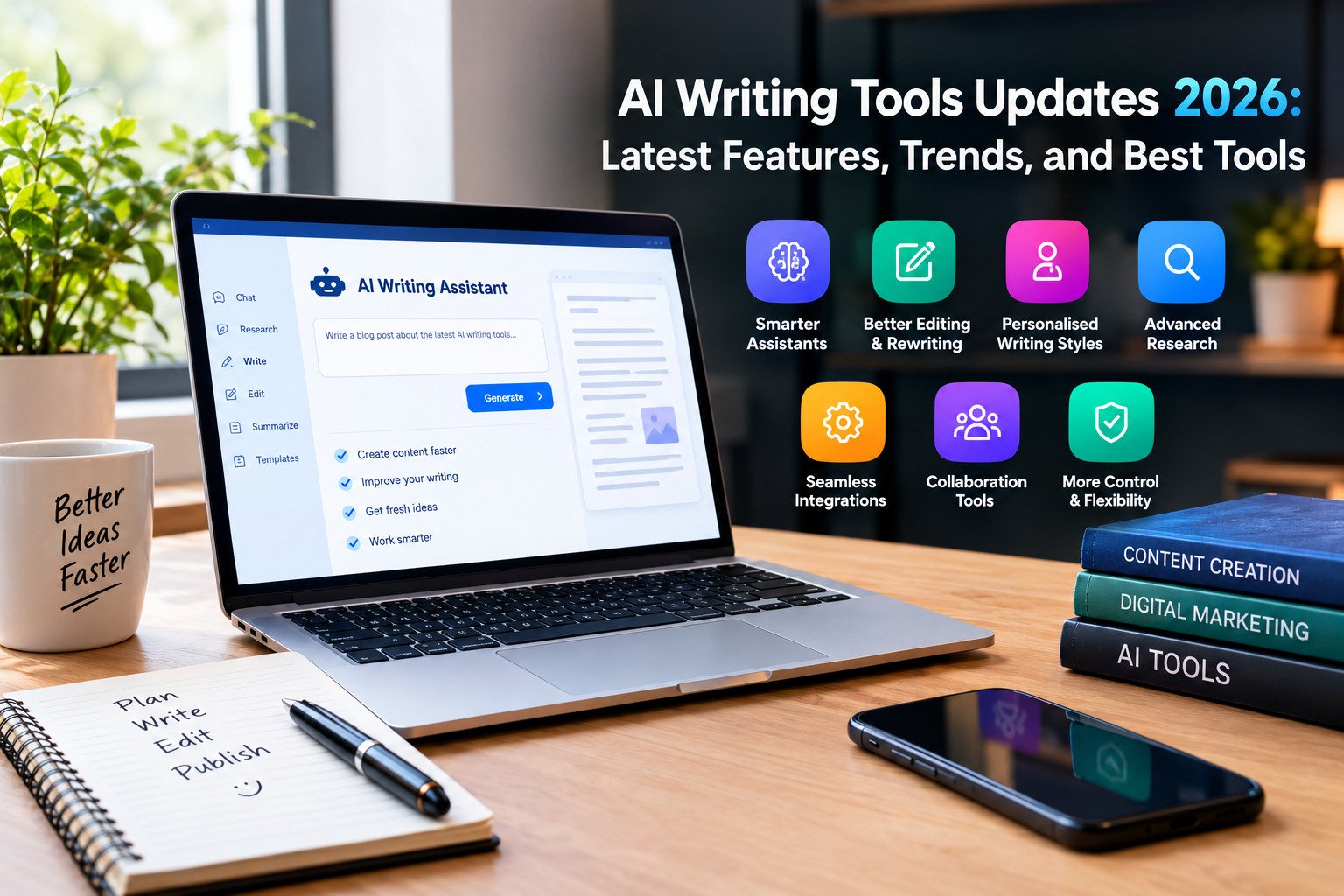
The latest AI writing tools updates in 2026 focus on smarter writing assistance, improved workflows, better integration with other applications, and more control over the final output. These developments can help people save time while maintaining a consistent writing style.
However, choosing the right tool still requires careful consideration. Some tools are better for long-form articles, while others are more suitable for grammar correction, marketing copy, or collaborative projects.
This guide explores the major developments in AI writing, the features worth understanding, popular tools to consider, and practical ways to use AI responsibly.
What Are AI Writing Tools?
AI writing tools are software applications that use artificial intelligence to assist with creating or improving written content. Depending on the platform, users can generate ideas, create outlines, rewrite sentences, summarise documents, correct grammar, or adapt content for different audiences.
For example, a blogger can use an AI assistant to develop an article outline before writing the full post. An ecommerce business can use one to prepare product descriptions, while an editor might use a separate tool to check spelling and sentence clarity.
Many applications combine several functions into one workspace, reducing the need to switch between multiple programs.
Common uses include:
- Writing blog posts and informational articles.
- Creating product descriptions and category pages.
- Developing social media captions and email campaigns.
- Rewriting unclear sentences and correcting grammar.
- Summarising research materials and lengthy documents.
- Generating outlines, headlines, and frequently asked questions.
- Adapting content for different audiences and formats.
AI can support these tasks, but the quality of the result depends on the instructions, available information, and human review.

Major AI Writing Tools Updates in 2026
The AI writing industry continues to develop, with improvements in both the writing experience and the technology behind it. The following trends are particularly relevant to content creators.
1. More Capable AI Writing Assistants
Modern AI assistants are moving beyond basic text generation. Depending on the product and subscription, they may help users plan an article, analyse supplied documents, compare information, revise drafts, and organise a complete content workflow.
OpenAI’s October 2026 release notes, for example, describe GPT-6 and Intelligent UI features in ChatGPT that combine text with visuals and interactive elements. This illustrates a broader shift towards assistants that can present information in different formats rather than responding only with plain text.
For writers, this type of development can make research and planning more convenient. A user might request an outline, compare alternative headlines, and refine a draft within one conversation.
The important point is to check each product’s official release notes before assuming a feature is available on every plan.
2. Improved Editing and Rewriting Features
Writing tools are increasingly useful for revising existing material instead of generating everything from scratch.
Depending on the application, editing features may help users:
- Simplify complicated sentences.
- Correct grammatical errors.
- Remove unnecessary repetition.
- Adjust tone for a particular audience.
- Improve transitions between sections.
- Make technical explanations easier to understand.
These capabilities are especially useful when a draft contains the right information but needs clearer presentation.
For the best results, give the tool specific instructions. For example, asking it to improve readability while preserving the original meaning is more useful than simply requesting a better article.
Always compare the revised version with the original to ensure that important details have not been removed or changed.
3. More Personalised Writing Styles
A common challenge with AI-generated content is that different articles can sound remarkably similar. Repeated expressions, predictable introductions, and generic conclusions can make content less engaging.
Personalisation features aim to help users establish a more consistent voice. Some writing applications support saved instructions, style preferences, brand guidelines, or reference documents.
A business could define its preferred tone as friendly, direct, and informative. A publication might use a more formal editorial style, while an online store could prefer concise descriptions focused on product benefits.
Even when a tool supports style customisation, users should provide examples of their own writing and review the output carefully. A saved style guide is a starting point, not a guarantee that every draft will sound natural.
4. Better Research and Document-Based Writing
Research is an essential part of producing useful content. An article may read smoothly but still be unreliable if its statistics, product specifications, or claims are incorrect.
AI tools that can work with supplied documents or connected information sources may help users organise research more efficiently. Writers can use these features to extract key points, identify unanswered questions, and build outlines from source material.
A responsible research process includes:
- Identify the topic and the questions readers need answered.
- Gather reliable sources, including official documentation where appropriate.
- Ask the AI tool to organise the supplied information.
- Verify important claims against the original sources.
- Add explanations, context, and examples that genuinely help readers.
Do not assume that an AI-generated reference, quotation, or statistic is accurate without checking it

.
5. AI Writing for Different Content Formats
Another important development is the ability to adapt a core idea for multiple publishing formats.
For example, one well-researched article could provide the starting point for a newsletter, social media post, short product guide, or video script. Each format still requires editing because readers behave differently across platforms.
A LinkedIn post may need a professional opening and a concise takeaway. A blog post may require detailed explanations and supporting sources. A product description should focus on verified features, practical benefits, and relevant buying information.
Repurposing content can save time, but copying the same text everywhere is rarely the best approach. Adapt the message to the purpose and audience of each channel.
6. Stronger Connections With Everyday Workflows
Writers often work across word processors, content management systems, project management tools, and marketing platforms. Integrations can help reduce repetitive tasks by making AI assistance available within existing workflows.
Depending on the product, integrations may support document editing, collaborative review, content planning, or publishing preparation.
For example, a content team might use AI to prepare a first draft, send it to an editor for review, and then transfer the approved copy into a publishing system.
Before adopting an integration, check its permissions, supported applications, data-handling policies, and pricing. Automation should make the workflow more efficient without removing necessary editorial checks.
Best AI Writing Tools to Consider in 2026
Different applications serve different needs. The following tools are useful starting points for comparing available features. Their exact capabilities, prices, and plan restrictions can change.
ChatGPT
ChatGPT can assist with brainstorming, outlines, article drafts, rewriting, explanations, and content planning. It is useful when a writer needs help moving through several stages of a project.
Best for: General writing assistance, ideation, and flexible content workflows.
Grammarly
Grammarly focuses on writing improvement, including grammar, spelling, clarity, and tone-related assistance. Depending on the plan and product features, it can help writers polish material before publication.
Best for: Proofreading, editing, and improving sentence clarity.
Jasper
Jasper is designed primarily for marketing and business content workflows. Its features may be useful for teams working on brand messaging, campaigns, and repeatable marketing tasks.
Best for: Marketing copy and brand-focused content production.
Copy.ai
Copy.ai has focused on AI-assisted marketing and go-to-market workflows. Its suitability depends on the user’s need for content generation, business process support, and available integrations.
Best for: Marketing teams and structured content workflows.
Writesonic
Writesonic offers AI-assisted writing and content-related tools. Depending on its current features and plan, it may be relevant to businesses working on articles, marketing content, and search-related projects.
Best for: Content creation and marketing support.
Before choosing a paid subscription, test each shortlisted tool on the same writing task. Compare factual accuracy, editing time, output quality, ease of use, and total cost rather than relying on promotional claims.
How AI Writing Tools Can Help With SEO
AI writing software can support search engine optimization when it is used to improve research, organisation, and readability. It does not automatically make an article rank well in Google.
Here are practical ways to use these tools in an SEO workflow.

Keyword and Topic Planning
Use an AI assistant to organise a list of target keywords into related topics and reader questions. Then validate search demand, competition, and search intent with appropriate SEO research tools.
Do not rely on AI alone to estimate keyword volume or difficulty.
Article Structure
AI can help create an outline with logical headings, supporting sections, and frequently asked questions. Review the outline to ensure that it covers the subject thoroughly without adding irrelevant sections simply to increase word count.
Content Optimisation
A writing assistant can help improve readability, explain technical concepts, and identify repeated ideas. Include target keywords naturally where they fit the subject.
Avoid awkward repetition or writing paragraphs solely to accommodate a keyword.
Content Refreshing
Older articles may need updated statistics, product details, screenshots, or explanations. AI can help identify potentially outdated sections, but the writer must verify current facts before changing the page.
Human Review and Original Value
The strongest SEO workflow combines AI assistance with real expertise, reliable sources, original examples, and useful answers.
Publishing large quantities of unreviewed AI content can create quality problems. Focus on whether each page genuinely satisfies the reader rather than how quickly it can be produced.
Benefits of AI Writing Tools
AI writing applications can offer several advantages when used appropriately.
- Time savings: They can speed up brainstorming, outlining, and routine editing.
- Consistent formatting: Templates and saved instructions can help teams follow editorial guidelines.
- Improved readability: Editing suggestions may make complicated sentences easier to follow.
- Content flexibility: Drafts can be adapted for different channels and audiences.
- Support for small teams: Individuals and small businesses can handle more routine writing tasks.
- Faster idea generation: AI can suggest alternative titles, angles, and questions when a writer feels stuck.
These benefits depend on the quality of the tool and the way it is used. AI should reduce unnecessary effort, not replace careful thinking.
Limitations and Risks to Understand
Despite ongoing improvements, AI writing tools still have limitations.
Incorrect information: A generated response may contain unsupported claims, outdated details, or invented references.
Generic language: Without clear instructions and thoughtful editing, the output may lack personality and meaningful detail.
Privacy concerns: Uploading confidential documents or customer information can create risks. Review the provider’s data policies and organisational rules before sharing sensitive material.
Copyright and originality questions: AI-generated text can resemble existing material or incorporate information in ways that require closer review. Check important passages and avoid copying protected work.
Overdependence: Relying entirely on automated writing can weaken research, editorial judgement, and subject expertise.
Uncertain pricing and availability: Features may be limited by subscription, region, usage caps, or staged rollouts.
A reliable workflow treats AI output as a draft that needs verification, rather than as a finished product that is automatically ready to publish.
How to Choose the Right AI Writing Tool
Choosing a tool becomes easier when you start with the task you need to complete.
- Define your main purpose. Decide whether you need blogging assistance, proofreading, product descriptions, email copy, or team collaboration.
- Set a realistic budget. Compare free plans, monthly subscriptions, usage limits, and additional costs.
- Test a real assignment. Use a task from your actual workflow rather than a simple demonstration prompt.
- Check accuracy. Verify factual statements, references, and technical details.
- Review editing requirements. A tool that produces a longer draft is not necessarily better if it requires extensive corrections.
- Evaluate privacy and integrations. Make sure the application fits your security requirements and existing workflow.
- Reassess regularly. AI products change quickly, so review official release notes and test important updates before changing your process.
The best tool is the one that consistently improves your work without adding unnecessary cost or risk.
The Future of AI Writing Tools
AI writing tools are likely to continue developing towards more integrated, context-aware, and collaborative workflows. Improvements in document handling, editing assistance, multimodal interfaces, and workflow automation may help writers manage more tasks from a single workspace.
At the same time, human judgement will remain essential. Writers must understand their audiences, verify information, recognise misleading claims, and make decisions about what deserves to be published.
For businesses, the long-term advantage will not come simply from generating more content. It will come from combining useful AI capabilities with accurate information, strong editorial standards, and a clear understanding of customer needs.
Conclusion
The main AI writing tools updates in 2026 reflect a move towards more flexible writing assistants, improved editing, personalised workflows, research support, and integrations with everyday software.
These tools can make content creation faster and help writers organise their ideas. However, they cannot guarantee factual accuracy, search rankings, or a natural writing style without appropriate review.
Whether you are a blogger, student, marketer, or business owner, start by identifying your biggest writing challenge. Test a few suitable applications, compare their output, and develop a process that includes fact-checking and human editing.
Used thoughtfully, AI writing tools can become valuable assistants while the writer remains responsible for the final result.
Frequently Asked Questions (FAQs)
1. What are the latest AI writing tools updates in 2026?
Important developments include more capable AI assistants, improved editing features, personalised writing workflows, document-based research, and integrations with other applications. Specific features vary by provider and subscription.
2. Which AI writing tool is best in 2026?
There is no single best tool for everyone. ChatGPT is useful for general writing assistance, Grammarly for proofreading, Jasper for marketing workflows, and other platforms may suit specialised needs. Compare them using your own tasks.
3. Can AI writing tools create SEO-friendly articles?
Yes. They can help with outlines, keyword organisation, readability, and content planning. However, writers still need to verify facts, understand search intent, provide original value, and follow current search engine guidance.
4. Are AI writing tools free to use?
Some provide free access with usage limits, while others require paid subscriptions for additional features or higher usage. Check the official pricing page for current terms.
5. Can AI writing tools replace human writers?
AI can automate parts of the writing process, but it does not eliminate the need for human judgement, expertise, fact-checking, and editorial decisions. Many people use it as an assistant rather than a complete replacement.
6. How can I make AI-assisted content more natural?
Provide a clear audience, a specific purpose, and relevant background information. Add genuine examples, remove repetitive sentences, verify claims, and edit the final draft to reflect your own voice.
7. Is AI-generated content allowed on websites?
AI assistance is not automatically prohibited. Website owners should focus on producing helpful, reliable content for readers and avoid publishing material designed primarily to manipulate search rankings. Review applicable platform policies and disclose AI use when required.
8. How often should I check for AI writing tool updates?
Check official release notes whenever you depend on a particular feature, and review major changes periodically. This helps you identify improvements, changed limits, new integrations, and features that may require a different subscription.
9. Can AI writing tools help with product descriptions?
Yes. They can draft descriptions, organise product benefits, and improve readability. Always verify specifications, sizing, materials, prices, and other product details before publishing.
10. What should I check before publishing AI-assisted content?
Verify factual claims and sources, remove repetitive or irrelevant material, check originality, review privacy and copyright concerns, and make sure the final article genuinely answers the reader’s question.

2 Comments
Pingback: How to Change a Tire: A Step-by-Step Guide for Beginners - Nerd Bot
Pingback: How to Clear Cache on iPhone: Step-by-Step Guide - Nerd Bot